
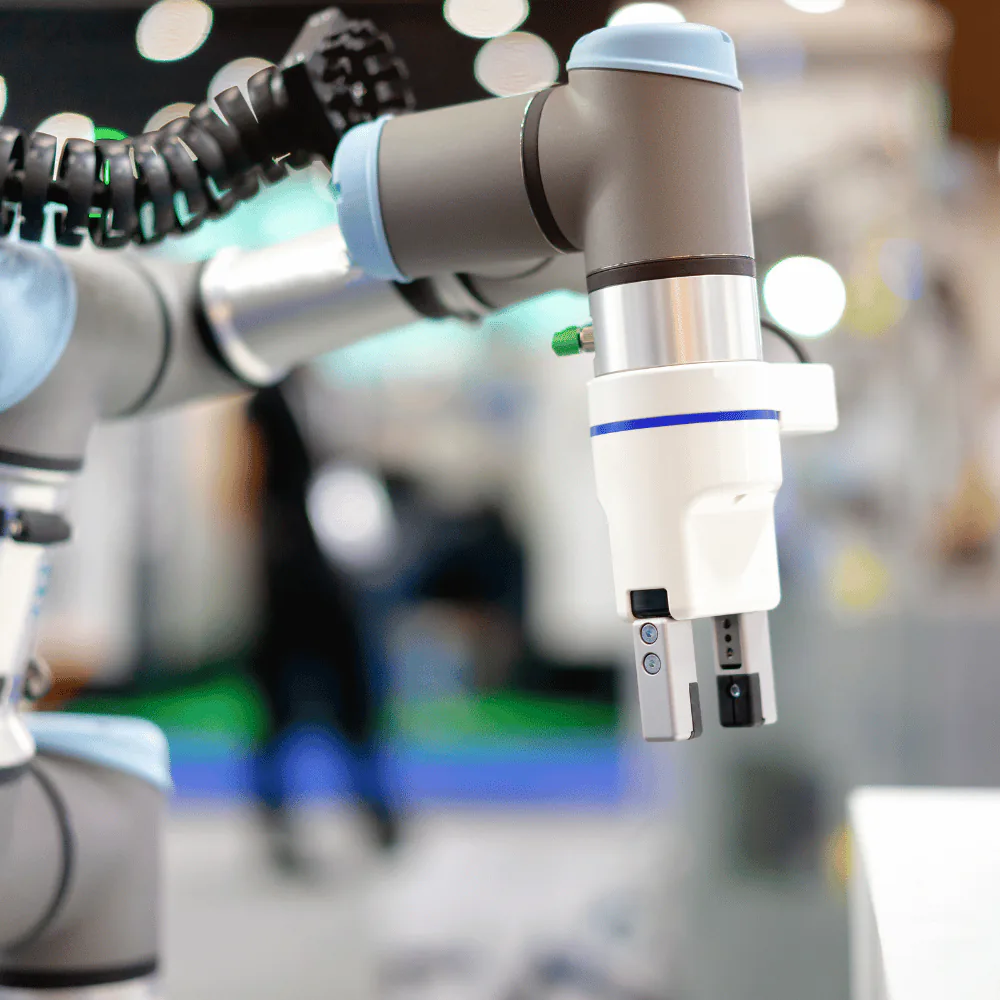
Is there a task that repeats every day and consumes time?
An operator repeats the same movement constantly.
A dedicated station can take over a defined repetitive action while the operator focuses on work that requires judgment.
Loading or unloading a machine consumes a significant part of the shift.
Automating the transfer can reduce idle time and keep the machine supplied consistently.
Parts must always be placed in the same position.
Fixtures, guides, and controlled motion can make positioning repeatable.
A manual operation varies from cycle to cycle.
Defined mechanisms and sequences help reduce variation without replacing the entire process.
The task creates physical effort or awkward movements.
Automation can improve ergonomics while keeping the operator involved where flexibility is valuable.
A process needs to be fed repeatably.
Feeders, mechanisms, or a robot can present each part with the orientation and timing the process needs.
There is idle time between one operation and the next.
A coordinated station can connect stages and make handoffs more predictable.
The sequence must remain constant to guarantee quality.
Controls, sensors, and defined states can supervise the conditions required before each action.
Only one part of the line justifies automation.
A focused station can address the bottleneck without transforming the whole factory.
You want more repeatability without replacing the entire process.
We define the smallest useful level of automation around the task and its measurable result.
A station designed around one concrete task
Part feeding
Present and position components so they reach the next process consistently.
Handling
Move parts between positions, stations, machines, and containers.
Loading and unloading
Automate part or all of the product entry and exit from a machine.
Assembly
Execute or assist repetitive placement, joining, pressing, and positioning operations.
Inspection
Verify presence, position, orientation, and defined characteristics with sensors or machine vision.
Classification
Separate parts according to the criteria established for the process.
Tooling and fixturing
Design fixtures, grippers, and mechanisms that manipulate the product repeatably.
Coordination between equipment
Synchronize the automated station with existing machinery and the surrounding process.
Conceptual example
How it works in practice
A machine where the operator loads a part, waits out the cycle and pulls the product. The sequence repeats hundreds of times per shift. An automated station adds the mechanisms and control needed to keep that handoff consistent.
Present the part consistently
The part arrives at a defined position so the station can receive it under the same conditions each cycle.
Verify and pick up
Sensors confirm that the part is ready before a mechanism or robot takes it.
Load and complete the cycle
The station places the part in the machine and coordinates with the process until the cycle finishes.
Remove the product
The finished product leaves the machine consistently, while the operator focuses on work that needs judgment.
The operator stops repeating the same movement and goes back to work that needs judgment.
You do not always need a robot
Dedicated mechanisms
Pneumatic or electric actuators and simple mechanisms are enough for many repetitive movements.
Linear axes
Use controlled travel between defined positions when the task requires it.
Collaborative robots
Evaluate them for flexible tasks, multiple positions, or processes that are reconfigured frequently.
Industrial robots
Use them when the process requires greater speed, reach, or payload capacity.
Semi-automatic stations
Keep the operator involved in part of the task while the system controls repetitive or critical operations.
Smart tooling
In some cases, automating the fixture or tooling creates more value than automating the entire station.
Working methodology
- 01
Observe the task
We understand how it is performed today, which movements it involves, how long it takes, and where variations or difficulties appear.
- 02
What is worth automating
We separate repetitive operations from those where human intervention remains the best option.
- 03
The concept
We define mechanisms, sensors, actuators, robot, tooling, and the operating sequence.
- 04
Build and integrate
We manufacture and configure the elements needed to implement the station.
- 05
Cycle after cycle
We verify sequences, cycle times, repeatability, fault detection, and behavior in representative scenarios.
- 06
Handoff
The responsible staff receives the station together with the corresponding documentation and training.
You can start by automating one movement
Initial scope
- Position one part
- Actuate one tool
- Remove one product
- Feed one machine
- Verify presence
- Classify components
- Automate one fixture
Future expansion
- New operations
- Automatic feeding
- Inspection
- Traceability
- Production records
- Robot integration
- Centralized supervision
The station as part of the rest of the process
Station + existing machinery
Exchange signals to coordinate start, end, and cycle conditions.
Station + monitoring
Record production, states, alarms, and operating times.
Station + machine vision
Detect orientation, presence, and product characteristics with a camera.
Station + traceability
Relate each part to its order or process using codes, labels, or another defined mechanism.
Station + production software
Send data to internal platforms through a compatible interface.
Station + other stations
Incorporate the station into a larger sequence as the process evolves.
Capabilities used
Frequently asked questions
Do I need a robot to automate my process?
Not necessarily. Many tasks are better solved with mechanisms, actuators, or semi-automatic stations, with less investment and maintenance.
How do we know whether a task is worth automating?
We evaluate frequency, cycle time, repetition, ergonomics, variability, volume, and complexity. Automation should solve a concrete problem, not be added merely to incorporate technology.
Can you integrate a robot with a machine we already have?
In most cases, yes. We review available signals, the operating sequence, safety requirements, and the appropriate way to coordinate both systems.
Do you work with collaborative robots?
Yes. We evaluate and integrate them when their characteristics are appropriate for the application.
Does a collaborative robot mean that I do not need guarding?
No. Safety depends on the complete application: tool, part, speed, force, environment, and interaction with people. A collaborative robot with a sharp tool or heavy part still requires a risk assessment.
Can you design the gripper?
Yes. We design tools, fingers, fixtures, and product-specific adapters when the application requires them.
What happens if we manufacture different parts?
We design flexible solutions using recipes, interchangeable tooling, or adjustments according to process characteristics. Product variety is a design input, not an obstacle.
Can I start with a semi-automatic station?
Yes, and it is often the most reasonable decision: automate repetitive tasks while keeping the operator on activities that require judgment or flexibility.
Can you record how many parts the station produces?
Yes. We can incorporate counts, times, alarms, and other data when they are part of the scope.
Does automation require stopping production?
Installation, integration, and commissioning require work windows on the process. We define the strategy with you to reduce the operational impact.
Puebla-based support and projects in other locations
- Geographic coverage
- Puebla and other regions
- Remote attention
- Design, programming, and manufacturing are performed from our facilities.
- In-person attention
- Survey, integration, testing, and commissioning take place directly on the process.
Projects are evaluated according to the task, location, access windows, and integration requirements.
Tell us which task repeats every day
You do not need to know whether the solution requires a robot, cylinder, sensor, or controller. Tell us what the operator does today, which part is handled, how often the operation repeats, how long it takes, what variations exist, which machine participates, and what result you would like to improve. With that information, we evaluate what level of automation makes sense for your case.
Technical components
The robot is not the project: before selecting technology, we understand the part being handled, the repeated movement, cycle time, product variation, available space, what happens before and after the operation, interaction with people, and the expected result. Sometimes a robot is correct; in other cases, a simpler mechanism solves the problem with lower cost and maintenance.
Safety is integrated from the design. Depending on the scope, the station considers emergency stops, guards, interlocks, access sensors, motion limits, safe states, energy control, behavior after loss of pressure, communication loss, sensor failures, recovery after interruption, shared work zones, and maintenance procedures. A collaborative robot does not eliminate risk assessment: safety depends on the complete application.
Tooling is designed around the product: grippers, custom fingers, suction cups, fixtures, stops, guides, positioning nests, quick-change systems, adapters, and alignment mechanisms. Each element considers geometry, material, tolerances, forces, and process conditions.
Control: PLC · HMI · state machines · recipes · motion control · production records. Actuation and robotics: collaborative and industrial robots · pneumatic and electric actuators · servo motors · stepper motors · variable-frequency drives.
Sensing and inspection: industrial sensors · proximity sensors · photoelectric sensors · encoders · machine vision · digital and analog signals. Communication: Modbus · RS-485 · industrial Ethernet · machine communication · data acquisition.
Engineering and manufacturing: CAD · CNC fabrication · 3D printing · risk assessment · safety systems. The specific architecture is defined according to the task, part geometry, cycle time, available space, operator interaction, required flexibility, and safety requirements.
Related projects: we publish only implementations that can be documented and shown. When a related case is available, it will identify the original task, the part automated, the selected architecture, mechanisms or robot, tooling, integrations, and documented results. Conceptual demonstrations will be identified explicitly.