
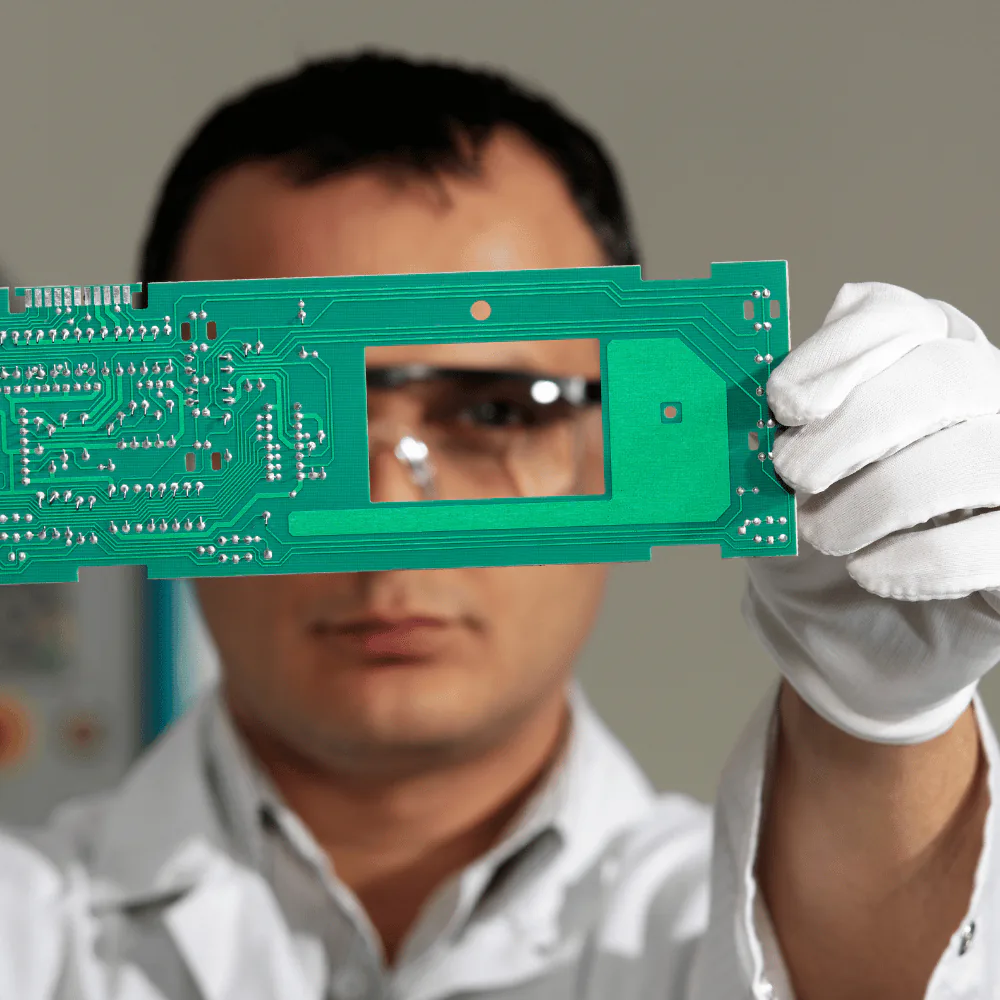
Do you have an idea that does not exist as a product yet?
You need an electronic device for a specific function.
We start with what the device must do and turn that need into a technical path.
An experimental prototype needs to become a robust device.
The development can replace improvised connections with an integrated architecture ready for the next test.
You need to validate a product idea technically.
A focused proof of concept can answer the most important feasibility question before a larger investment.
No commercial equipment covers the need exactly.
A custom device can combine the required function, interface, size, and integration in one product.
Sensors, actuators, or communications must live inside your own device.
Electronics and firmware are designed around the environment and the behavior the product needs.
You need a custom electronic board.
The circuit can evolve from a prototype arrangement to a PCB prepared for assembly and future versions.
A solution made of modules and cables needs to become a product.
Integration improves reliability, serviceability, repeatability, and the clarity of the final system.
Electronics, software, and enclosure need to be designed together.
A combined view prevents decisions in one discipline from creating problems in another.
The development must move toward small or medium production runs.
The design can evolve with manufacturing files, bills of materials, tests, and documentation for the next stage.
From concept to functional prototype
Electronic architecture
Define the main system blocks and how they interact.
Circuit design
Select components and develop the schematics required by the product function.
PCB design
Convert the circuit into a board prepared for manufacturing and assembly.
Firmware
Program the microcontroller or processor that governs sensors, actuators, communications, and behavior.
Sensors and actuators
Integrate the elements with which the device measures or acts on its environment.
Communications
Select wired or wireless interfaces according to the project requirements.
User interface
Design buttons, indicators, screens, and other elements that define the use experience.
Enclosure and mechanical integration
Develop supports, enclosures, and parts that turn the electronics into a usable device.
Conceptual example
How it works in practice
A company that needs a specialized controller for its own equipment and currently operates with commercial modules connected manually. A custom development replaces that collection with a product architecture that can be tested, documented, and improved.
Define the device function
We turn the required behavior, environment, interfaces, and constraints into a clear technical target.
Design the architecture and prototype
The system blocks are defined and a first prototype answers the most important feasibility question.
Build the board and firmware
The circuit becomes an integrated PCB and the firmware governs its sensors, actuators, communications, and behavior.
Integrate, test, and document
Electronics, firmware, and enclosure are validated together and documented as a platform that can evolve.
You end up with one controller you own, instead of a stack of modules wired together.
Not every device should be born as the final product
Proof of concept
Answer whether the main function is technically feasible.
Functional prototype
Verify that the equipment behaves as expected in real use.
Integrated prototype
Bring electronics, firmware, and enclosure together as one complete product.
Design for manufacturing
Refine components, PCB, assembly, and documentation for production.
Product evolution
Add new functions over a base that has already been validated.
Working methodology
- 01
What the device has to do
We define functions, users, environment, interfaces, power, and the main constraints.
- 02
Design the architecture
We select the electronic and mechanical blocks needed to meet the requirements.
- 03
First prototype
We develop prototypes to validate circuits, firmware, and behavior.
- 04
Electronics, firmware and enclosure together
We refine PCB, firmware, enclosure, and interfaces as parts of one system.
- 05
Validate the design
We test representative scenarios and correct detected issues before moving toward manufacturing.
- 06
Files for the next stage
We deliver the files and documentation corresponding to the agreed scope.
You can start with the most important function
Initial scope
- Validate one sensor
- Control one actuator
- Demonstrate one communication
- Test a power architecture
- Build an initial board
- Develop basic firmware
- Verify one critical interaction
Future expansion
- A more compact PCB
- A better user interface
- An enclosure
- Connectivity
- Firmware updates
- Extended testing
- Production preparation and certifications
The device as part of a larger system
Device + application
Communicate with a web, mobile, or desktop application.
Device + cloud or private server
Store and consult data from external or privately managed infrastructure.
Device + machinery
Interact with existing sensors, controllers, and equipment.
Device + monitoring panel
Visualize and analyze the variables recorded by the product.
Device + automation
Operate as a module inside a machine or automated station.
Device + firmware updates
Include maintenance and embedded-software update mechanisms when the architecture supports them.
Capabilities used
Frequently asked questions
Do I need to have the circuit designed?
No. We start from a functional need and develop the electronic architecture from it.
Can you develop only the PCB?
Yes. The scope can be limited to electronic design or also include firmware, mechanical integration, and enclosure.
Can you manufacture the prototypes?
Yes. When included in the scope, we perform or coordinate the manufacturing and assembly needed to validate the design.
Can you also develop the firmware?
Yes. We develop embedded software that controls the device, including communication protocols and update mechanisms.
Can you design the enclosure?
Yes. We design enclosures and mechanical elements around the electronics, connectors, mounting, and intended use.
Can you produce many units?
We prepare the design and documentation for manufacturing and define the production strategy with you. Volume, process, and suitable suppliers depend on the product.
What happens if a component becomes unavailable?
Component availability and lifecycle are design criteria from the start. When necessary, we evaluate alternatives and update the design.
Can I retain ownership of the design?
Yes. Intellectual-property and file-delivery conditions are established by contract at the beginning of each project.
Can you connect the device to an application?
Yes. We develop or integrate the complementary software required by the project.
Will I need certifications?
It depends on the product, market, application, and how it will be commercialized. Regulatory requirements should be identified early because incorporating them from the design is less expensive than redesigning later.
Puebla-based support and projects in other locations
- Geographic coverage
- Puebla and other regions
- Remote attention
- Electronic design, firmware, CAD, and prototype development are performed from our facilities.
- In-person attention
- When the product requires integration with existing equipment or on-site testing, we evaluate the project requirements.
Projects are evaluated according to the device, environment, access, production stage, and integration requirements.
Tell us what device you have in mind
You do not need to arrive with complete electronic specifications. Tell us what problem it should solve, who will use it, what it needs to measure or control, where it will operate, which systems it must communicate with, what size or cost constraints it has, and which development stage you need to reach. With that information, we define an initial technical scope.
Technical components
Designing for prototyping is not the same as designing for manufacturing. A product prepared for production must also address component availability, unit cost, assembly, tolerances, production testing, connectors, accessibility, maintenance, documentation, unit-to-unit repeatability, and component substitution.
We design for use: installation location, temperature and environmental conditions, users, power, connectivity, failure behavior, updates, diagnostics, and replaceable parts all influence the device architecture from the first day.
Before scaling, we define tests for power, consumption, communications, inputs and outputs, sensors, actuators, temperature behavior, extended operation, failure recovery, firmware updates, and abnormal conditions according to the product's maturity and intended use.
Processing: microcontrollers · microprocessors · embedded systems · RTOS · bootloaders · non-volatile storage · firmware updates.
Hardware: PCB design · schematics · multilayer layouts · power supplies and voltage regulation · drivers · sensors and actuators · ADC and DAC · analog interfaces · GPIO.
Communication: I²C · SPI · UART · RS-485 · CAN · USB · Ethernet · Wi-Fi · Bluetooth.
Product and manufacturing: design for manufacturing (DFM) · bills of materials (BOM) · manufacturing files · prototyping · 3D printing · CAD and enclosure design · functional testing. The specific architecture is defined according to functions, environment, power, connectivity, size, target cost, expected volume, and required maturity.
Related projects: we publish only developments that can be documented and shown. When a related case is available, it will present the need that originated the product, required functions, prototype evolution, disciplines involved, relevant technical decisions, and documented results. Concepts and demonstrations will be identified explicitly.