
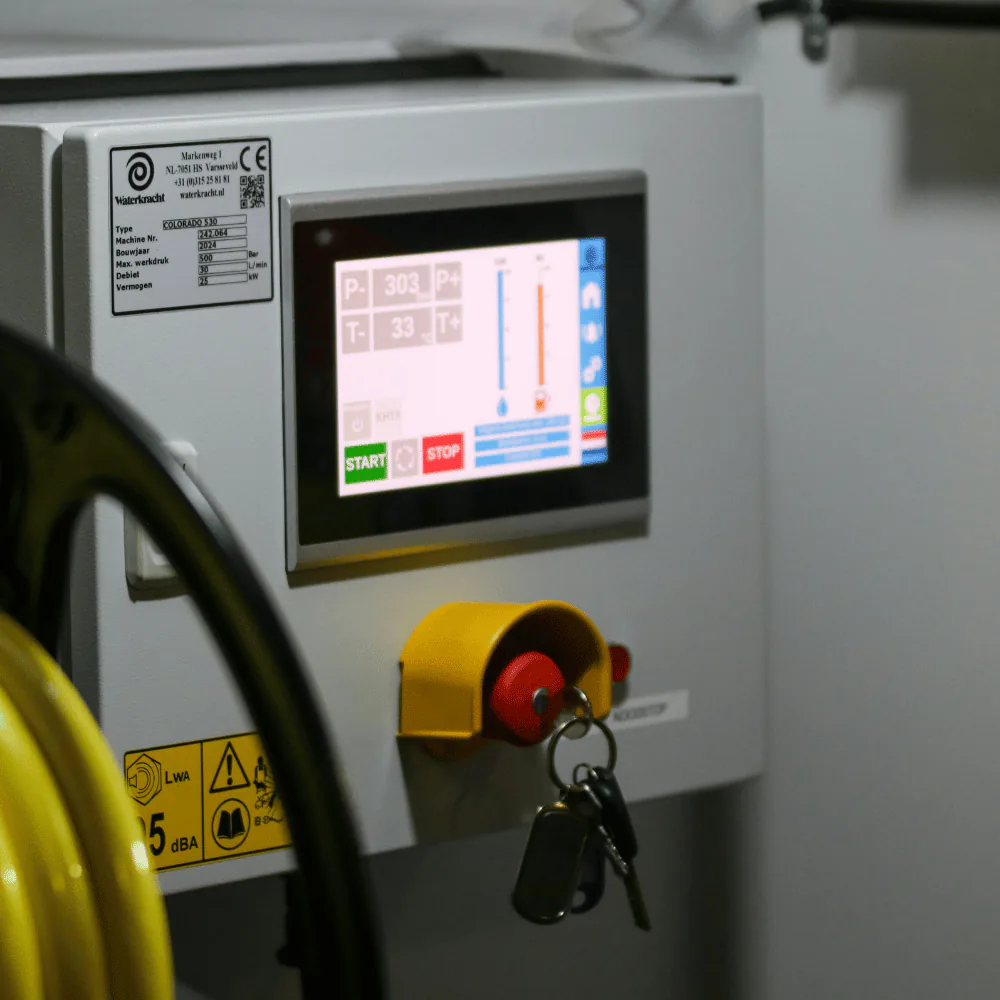
Your machine still works, but its control has fallen behind
The machinery still works, but its controls are old or difficult to maintain.
A retrofit can preserve the useful mechanics while replacing the parts that create operational or maintenance risk.
Adjustments still depend on knobs, relays, or manual procedures.
A controller and a clearer interface can make the operation more repeatable and easier to diagnose.
Different products need different parameters.
Recipes let the operator recover an approved configuration without rebuilding it from memory or notes.
The machine needs new sensors or measurements.
Instrumentation can make positions, conditions, and process variables visible to the control system.
Production and downtime are not recorded.
Cycle counts, operating time, stops, and events can become useful information for the operation.
Repeatability depends on operator experience.
Stored parameters, supervised sequences, and clear feedback reduce unnecessary variation.
The operator needs a clearer interface for operation and diagnosis.
A focused HMI can expose the states, parameters, alarms, and next actions that matter.
Original components are discontinued or difficult to source.
The modernization can reduce dependence on a specific controller, interface, relay, drive, or electronic board.
The machine needs to connect with other systems.
Industrial communication and an appropriate integration layer can expose useful data without disrupting the core process.
Replacing the entire machine is not the best option.
We first evaluate whether a focused intervention can deliver the required result with a reasonable scope.
Keep what works. Improve what limits your operation.
New controls
Replace or add controllers to manage sequences, actuators, and operating conditions.
Operator interfaces
Use screens and panels to configure parameters, consult states, and obtain diagnostic information.
Sensors
Add position, temperature, pressure, presence, level, and other process measurements.
Recipes and parameters
Store configurations for different products, processes, or operating conditions.
Production records
Count cycles and pieces, record operating and downtime, and keep relevant events.
Alarms and diagnostics
Detect abnormal conditions and give operators and maintenance staff clear information.
New actuators
Integrate motors, valves, relays, drives, and other elements when the process requires them.
Connectivity
Make equipment data available to other systems in the organization through the appropriate communication layer.
Conceptual example
How it works in practice
A machine that runs its mechanical process correctly, but whose adjustments depend on manual controls. Every product change requires the operator to adjust several parameters based on previous notes. With a modernization, the system adds control and information around the mechanisms that still work.
Keep what already works
The mechanical process and reliable components remain in place when they still serve the operation.
Make the real state visible
Sensors and an interface replace guesswork with the information needed to adjust the machine.
Store configurations as recipes
Product changes become repeatable because the relevant parameters can be recalled instead of rebuilt from notes.
Supervise and record the sequence
The control layer follows the operation and records relevant events for diagnosis and improvement.
The machine keeps doing what it did. It just stops depending on the operator's notes.
A modernization can be focused or extensive
Focused update
Replace an obsolete component or add one specific function without redesigning the complete machine.
Operational improvement
Add interfaces, sensors, stored parameters, or diagnostic tools that make daily work clearer and more repeatable.
Control renewal
Replace a larger part of the control system when the existing architecture has become a significant limitation.
Integration with other systems
Exchange information with compatible external systems when there is a concrete operational need.
Working methodology
- 01
Getting to know the machine
We review what the equipment does, how it operates today, which components it uses, and what problem needs to be solved.
- 02
What is worth keeping
We identify the mechanical, electrical, and control elements that can remain in service reliably.
- 03
Design the modernization
We define the new architecture, components, interfaces, and modifications required by the agreed scope.
- 04
Integration and programming
We build, configure, install, and program the agreed elements and control logic.
- 05
Running it in production
We verify sequences, parameters, sensors, alarms, and critical scenarios before handoff.
- 06
Documentation and handoff
We deliver the documentation, backups, and training defined for operation and maintenance.
You can start with one concrete improvement
Initial scope
- Add one sensor
- Replace one controller
- Add a screen
- Automate one adjustment
- Record cycles
- Add one alarm
- Replace one obsolete component
Future expansion
- Recipes and new operating modes
- Additional instrumentation
- Remote supervision
- Integration with production systems
- New automation stages
- Better diagnostic tools
The machine as part of a larger system
Machinery + monitoring
Make states, variables, counts, and alarms visible from a supervision platform.
Machinery + production
Record cycles, times, and events for internal production follow-up.
Machinery + traceability
Relate a product, order, or batch to the parameters with which it was processed.
Machinery + maintenance
Use alarms and operating hours as a basis for maintenance planning.
Machinery + other stations
Exchange signals with the equipment before and after the machine in the process.
Machinery + internal software
Integrate equipment data with production or management applications through an appropriate interface.
Capabilities used
Frequently asked questions
Can any machine be modernized?
No. We first evaluate its condition, documentation, architecture, available signals, risks, and economic viability. If modernization does not make sense, we will tell you.
Do I have to replace the entire control cabinet?
Not always. The intervention may be limited to one section if the rest of the installation remains suitable.
Can you work with a machine that has no documentation?
Yes. The lack of documentation increases the survey work needed to understand the equipment, so the scope is defined after that stage. The machine can be documented as part of the project.
Can the current sensors and actuators be kept?
Often, yes. We review their condition, signals, power, compatibility, and function within the system.
Can you replace an old PLC with a modern one?
Yes. However, the previous program can rarely be transferred directly: the machine's current behavior must first be understood and documented.
Can I add a screen to an existing machine?
In most cases, yes, provided there is an appropriate way to integrate it with the control system.
Can different production configurations be saved?
Yes. We implement recipes and parameters associated with different products or operating modes.
Can I consult machine data from another computer?
Yes, through a network integration or supervision system, according to the controller and infrastructure available.
Does modernization require stopping the machine?
Installation and testing stages normally require access to the equipment outside production. We plan those windows with you to minimize operational impact.
Does Palloran Labs also manufacture the parts needed for the modification?
Yes. When included in the scope, we design and manufacture supports, adapters, enclosures, and other elements needed for the integration.
Puebla-based support and projects in other locations
- Geographic coverage
- Puebla and other regions
- Remote attention
- Design, programming, and component preparation are performed from our facilities.
- In-person attention
- Survey, installation, testing, and commissioning take place directly on the machinery.
Projects are evaluated according to the equipment, location, access windows, and integration requirements.
Tell us what you want to improve in your machine
You do not need to know which PLC, sensor, or controller to use. Tell us what the machine does today, what problem it has, what functions you want to add, which parts still work correctly, which components cause problems, and what result you expect from modernization. With that information, we evaluate the equipment and define a reasonable intervention.
Technical components
First we understand the machine: its function, the parts that still work correctly, maintenance risks, available signals, physically feasible modifications, behavior that must be preserved, and the result the user expects.
The initial evaluation distinguishes whether a focused modification solves the problem or whether a deeper intervention becomes less convenient than replacing the equipment. We will explain that distinction clearly.
Safety before automation: depending on the scope, the design considers emergency stops, interlocks, existing protections, motion limits, safe states, startup sequences, behavior after power loss, sensor failures, communication loss, access to risk zones, and maintenance procedures. A modern interface or new function never replaces an appropriate safety architecture; specific requirements depend on the equipment, process, and applicable regulations.
Obsolescence and maintainability: we evaluate discontinued controllers, proprietary interfaces, old relays and timers, power supplies, drives, screens, communication modules, and specific electronic boards. The goal is often to keep the machine maintainable for many more years with available components and clear documentation.
Related projects: we publish only work that can be documented and shown. When an appropriate case is available, it will identify the initial state, problem, preserved components, modernized elements, disciplines involved, and documented results. Conceptual architectures and demonstrations will be identified as such.
Control: PLC · HMI · relays and contactors · state machines · recipes · alarms · cycle records. Movement and actuation: variable-frequency drives · servo motors · stepper motors · encoders · pneumatic actuators · valves · motion control.
Signals and instrumentation: industrial sensors · digital inputs and outputs · 4–20 mA and 0–10 V analog signals · data acquisition. Communication: RS-485 · Modbus · industrial Ethernet and other industrial networks · gateways · integration with existing systems.
Engineering and manufacturing: control cabinet design · electrical documentation · CAD · fabrication of integration parts. The specific architecture is defined according to the machine, process, intervention level, risks, component availability, and project objectives.