
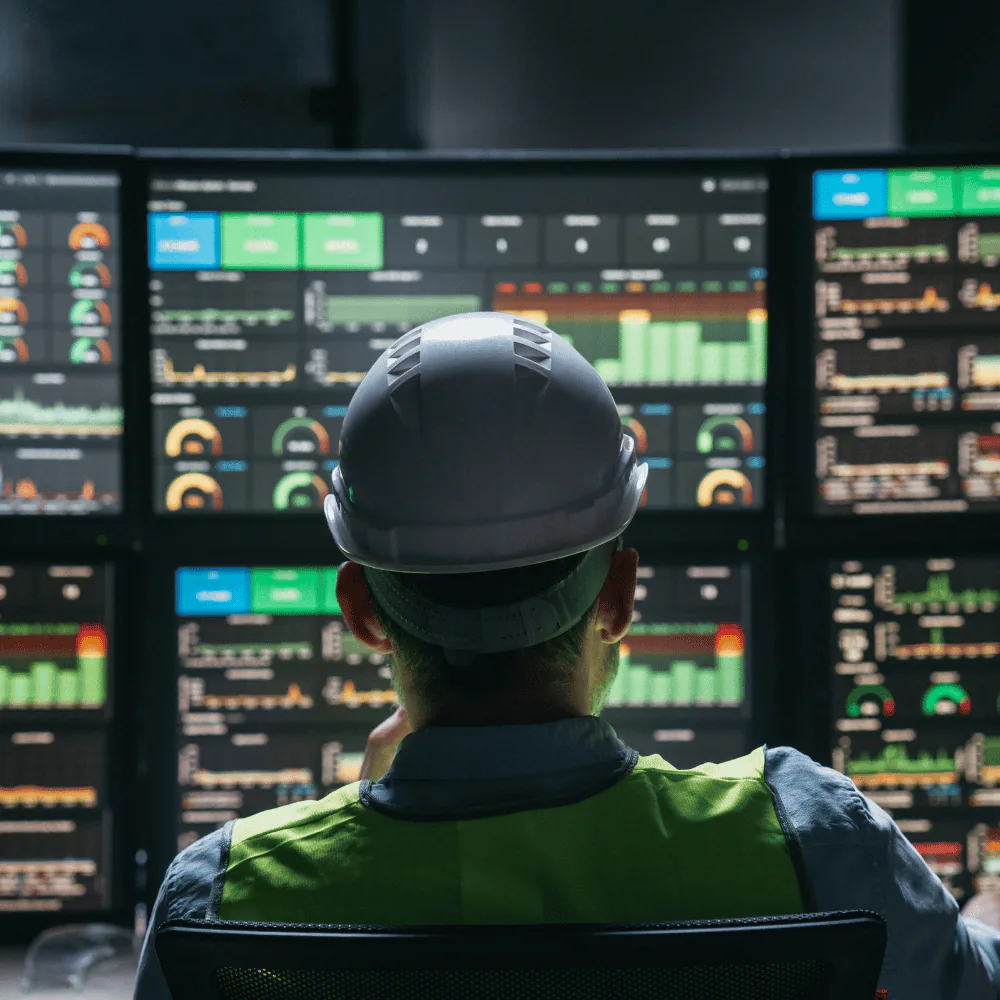
What happens in your operation when nobody is looking?
Temperatures, levels, and equipment states are checked manually.
The operation depends on someone being available to take a reading at the right moment.
There is no visibility outside working hours.
A remote system keeps relevant conditions visible even when the team is not on site.
Equipment can leave its parameters without anyone noticing.
A defined limit turns an unnoticed deviation into an event that can be attended.
There is no reliable measurement history.
Records make it possible to understand what happened before, during, and after an event.
The team needs alerts when a value leaves its range.
Notifications can be routed to the people responsible for responding.
Several people depend on the same information.
A shared view reduces duplicated checks and different versions of the same reading.
Equipment is distributed across areas or locations.
Connectivity and identification keep each measurement attached to the right asset.
Paper logs are hard to compare and follow up.
Digital history makes trends, events, and pending actions easier to review.
Turn physical conditions into useful information
Temperature
Monitor cold chains, rooms, equipment, and processes where temperature matters.
Humidity
Track environmental conditions that affect products, materials, and equipment.
Level
Know how much remains in tanks, containers, reservoirs, or other assets.
Flow
Observe the movement of water, air, gas, or another process fluid.
Equipment state
Register whether a machine, pump, door, motor, or other device is on, off, open, closed, or in alarm.
Electrical variables
Monitor current, voltage, consumption, and other electrical values when they help explain equipment behavior.
Query panel
Give the team a clear place to see current values, assets, history, and events.
Alerts
Notify the right people when a value, state, connection, or other condition requires attention.
Conceptual example
How it works in practice
A company with several refrigerators holding temperature-sensitive product. Today someone walks the units and writes down each reading. With a monitoring system, every reading stays associated with its equipment and can be consulted together with its alerts.
Measure each piece of equipment
Each refrigerator has a defined measurement point associated with the equipment it monitors.
Transmit and keep the readings
Readings arrive at the system and remain available as a history by equipment, variable, and time.
Evaluate the limits
The system compares each value with the range that matters for the product, process, or risk.
Alert the responsible person
A deviation becomes an actionable event instead of waiting for someone to be in front of the equipment.
Nobody has to be standing in front of the equipment at the right moment.
Monitoring is more than showing a graph
Current values
See the latest measurement for each sensor or equipment point.
History
Keep a record that can be reviewed by equipment, variable, date, or event.
Trends
Identify gradual changes, recurring patterns, and conditions that precede an event.
Events
Record when a limit, state, connection, or other relevant condition changed.
Configurable limits
Define acceptable ranges according to the equipment, process, and risk involved.
Notifications
Send notices when a value or event requires a response from the team.
Asset identification
Keep every reading connected to the exact refrigerator, tank, pump, room, or machine.
Reports
Prepare useful records for operation, maintenance, audits, or decision-making.
Working methodology
- 01
Walking the equipment
We identify the equipment, variables, limits, people, locations, and decisions that matter.
- 02
The first scope
We select the first equipment or process and the smallest useful set of measurements.
- 03
Choosing how to measure
We choose sensors, signal conditioning, acquisition, connectivity, storage, and alert paths according to the environment.
- 04
Build and install
We develop the necessary electronics and software, place the measurement points, and connect the system.
- 05
Against real conditions
We compare readings, limits, notifications, history, connectivity, and behavior with the actual operation.
- 06
Handoff
We leave the team with the information needed to operate, maintain, expand, and interpret the system.
You can start with one piece of equipment
Initial scope
- One piece of equipment
- One variable
- One sensor
- Its history
- One alert rule
- A limited group of users
Future expansion
- More sensors and equipment
- New locations
- Additional variables
- Reports and integrations
- Automation
- Maintenance based on historical data
Integration with other systems
Monitoring + alerts
Combine current values, history, ranges, and notifications in one operational view.
Internal software
Make monitoring information available in the portal or application your team already uses.
Maintenance
Use events and history to support inspection, diagnosis, and preventive maintenance.
Automation
Connect a monitored condition with a controlled response when the project requires it.
Multiple locations
Bring distributed equipment into a common view while keeping its location and identity clear.
Private infrastructure
Evaluate local, cloud, or hybrid operation according to data, connectivity, and control requirements.
Capabilities used
Frequently asked questions
What variables can be monitored?
Temperature, humidity, level, flow, pressure, current, voltage, consumption, equipment states, and other measurable conditions can be considered.
Does the site need internet?
Not always. The architecture may use local networks, cellular connectivity, the internet, or a combination, depending on the location and the required access.
What happens if the connection is lost?
The system can detect the interruption and, when required, keep readings locally until communication is restored. The behavior is defined during design.
Can several pieces of equipment share one system?
Yes. Equipment can be grouped by location, process, type, or responsibility while keeping each measurement identified.
Can alerts arrive on a phone?
Yes. Depending on the project, notifications may be delivered through the selected channels and to the responsible people.
Can existing sensors be reused?
Sometimes. We first review their signal, precision, condition, documentation, and compatibility with the new acquisition system.
How precise can the measurement be?
Precision depends on the variable, sensor, installation, calibration, sampling, and operating conditions. It is defined according to the decision the measurement must support.
Can the system also control something automatically?
Yes, when the scope, safety conditions, and control architecture allow it. Monitoring and control are defined separately so the response is appropriate to the risk.
Can the history be retained long term?
Yes. Storage, retention, backup, and consultation rules are selected according to the volume, sensitivity, and purpose of the data.
What maintenance does the system require?
The maintenance plan may include sensor inspection, calibration, connectivity checks, backups, software updates, and review of alert rules.
Puebla-based support and projects in other locations
- Geographic coverage
- Puebla and other regions
- Remote attention
- Software development and part of the configuration can be performed remotely.
- In-person attention
- Instrumentation, sensor installation, physical tests, and machinery integration may require on-site work, depending on the project.
The working model is agreed according to the equipment, location, connectivity, and integration requirements.
Tell us what you need to monitor
You do not need to arrive with sensors or a defined architecture. Tell us what equipment or process you want to supervise, which variable matters, what happens when it leaves its range, how often you need to know its status, who should receive the information, and whether you need monitoring only or also an automatic response.
Technical components
Measurement: analog and digital temperature, humidity, pressure, level, flow, current, and voltage sensors · signal conditioning · analog-to-digital conversion · microcontrollers · data acquisition devices.
Communication: RS-485 · Modbus · Ethernet · Wi-Fi · MQTT · gateways · APIs.
Platform: time-series databases · dashboards · rules and events · alerts · edge computing · local storage and synchronization · private or cloud servers · system monitoring.
Integration: PLCs and existing control systems. The final architecture is selected according to the variable, precision, installation conditions, connectivity, data retention, response time, security, maintenance, and growth expected from the system.
A monitoring system is only useful when the information it presents is reliable. Sensor selection, precision, installation location, sampling frequency, calibration, detection of disconnection or failure, communication-loss behavior, local buffering, backups, system supervision, and redundancy are evaluated as part of the design.
A system may be limited to observing conditions or may also trigger a controlled response: activate ventilation, stop a process, start a pump, change an operating mode, or signal another controller. Any automatic action is defined with its safety conditions and should not replace the protections required by the equipment or process.