
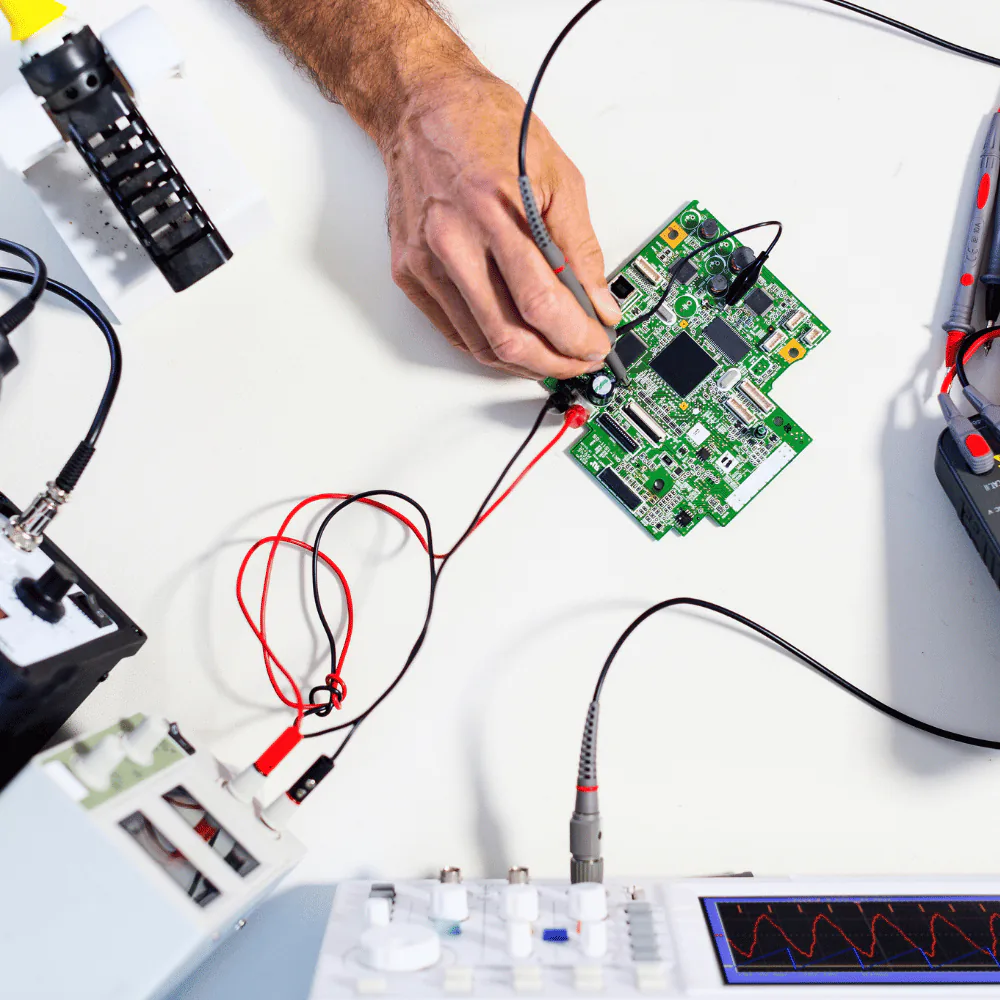
Do you need to teach a technology more practically?
Theory needs to be complemented by work on real equipment.
A practical station gives concepts a physical and observable context.
Commercial kits do not cover the course objectives.
A custom platform can align hardware, software, exercises, and assessment with the subject.
Stations must be reusable across student generations.
Durable construction, documentation, and replaceable components make the investment useful over time.
Students need to work with sensors, actuators, robots, or industrial systems.
The equipment can expose real signals and behaviors at an appropriate level of access.
Practices need to be documented clearly and consistently.
Guides, diagrams, expected results, and recovery steps help different groups repeat the experience.
Hardware, software, and teaching material must be one experience.
The platform is designed so the technology supports the learning goal instead of distracting from it.
The current laboratory no longer represents current technologies.
A modular station can update the practical experience without discarding every existing resource.
Practices need to align with a specific subject.
We start from the course, level, prior knowledge, and learning outcomes rather than from a catalog device.
Teachers need training before using new equipment.
Training and instructor material help the institution operate the station with autonomy.
The platform should grow with new exercises or modules.
An open architecture allows future practices, difficulty levels, and disciplines to be added.
We design around learning
Robotics stations
Teach programming, trajectories, sensors, manipulation, and automation concepts.
Electronics workbenches
Experiment with circuits, microcontrollers, sensors, actuators, and communications.
Automation modules
Practice PLC, HMI, instrumentation, sequences, and industrial control.
Manufacturing equipment
Learn CAD, digital fabrication, prototyping, and production processes.
Embedded-systems platforms
Work with firmware, communication buses, data acquisition, and hardware control.
Multidisciplinary stations
Combine mechanics, electronics, software, and control in one practical experience.
Practices and exercises
Prepare structured material that accompanies equipment use.
Teacher and student documentation
Provide operation guides, procedures, diagrams, and reference material.
Conceptual example
How it works in practice
A university that wants to teach collaborative robotics. Instead of limiting the class to simulation or instructor demonstrations, a station lets students work directly with the system and connect each action to a learning objective.
Recognize the system and safety
Students identify the robot, tool, sensors, controller, and safety elements before operating the station.
Execute a guided practice
They program movements, positions, and sequences while connecting each action to the learning objective.
Integrate signals and solve a challenge
They use information from the environment to make decisions and modify the solution with greater autonomy.
Document the result
Configurations, observations, and technical decisions turn the practice into knowledge that can be repeated and improved.
Students touch the robot instead of watching someone else touch it.
Not every laboratory needs to be complex
Introductory module
Focus on basic concepts and guided operation.
Intermediate station
Let students modify parameters, sequences, and configurations.
Open platform
Let students develop their own programs, circuits, and integrations.
Multidisciplinary laboratory
Let several areas use the same equipment from different perspectives.
Integrative project
Use the station as the base for students to design a complete solution.
Working methodology
- 01
What the course needs to teach
We review the subject, academic level, prior knowledge, and expected learning outcomes.
- 02
Designing the practice
We define what students will do, which equipment they need, and how practices will progress.
- 03
Build the station
We develop or integrate the mechanical, electronic, control, and software elements required.
- 04
Writing the exercises
We prepare activities, instructions, and challenges aligned with the academic objective.
- 05
A group of students tries it
We verify that the station is understandable, repeatable, and appropriate for the expected level.
- 06
Training the teaching staff
Teaching staff receives the equipment, documentation, and corresponding training.
You can start with one practice
Initial scope
- One station
- One learning objective
- One practice
- A small group
- Essential documentation
- Initial training
Future expansion
- New practices
- Additional modules
- More sensors
- Software
- New difficulty levels
- Several stations
- Cross-subject integration
- Final projects
One station can teach several disciplines
Robotics + programming
Teach sequences, trajectories, logic, and behavior.
Electronics + embedded systems
Integrate sensors, interfaces, and controllers into the station.
Automation + PLC
Practice signals, sequences, and industrial integration.
CAD + manufacturing
Let students design tools, supports, or modifications for the station itself.
Networks + connected systems
Teach communication between devices and services.
Documentation + engineering
Make diagrams, procedures, and technical records part of the practice.
Capabilities used
Frequently asked questions
Can you design a station for a specific subject?
Yes. We start from the subject's objectives, content, and academic level to define the platform.
Do we have to buy all new equipment?
Not necessarily. We evaluate existing hardware and determine what can be reused.
Can you also develop the practices?
Yes. Exercises, documentation, and support material can be part of the project when defined in the scope.
Can you train teachers?
Yes. Teacher training can be included in delivery, and we generally recommend it because an untrained team underuses the equipment.
Can you manufacture several identical stations?
Yes. Once the design is validated, we evaluate manufacturing multiple units.
Can one station be used in different subjects?
Often, yes. We design modular or sufficiently open platforms to support practices in different areas.
Do you work with collaborative robotics?
Yes. We integrate collaborative robots when appropriate for the academic objectives and project safety conditions.
Can you develop a station with equipment we already have?
Yes. We first review compatibility, condition, and integration possibilities.
Does the institution receive the files and documentation?
Yes. Deliverables are established by contract and include technical documentation, configuration files, manuals, and what is needed to operate and maintain the station.
Can you update a station later?
Yes. When the architecture allows it, we develop new practices, modules, or functions in later stages.
For universities, training centers, and businesses
- Geographic coverage
- Universities, training centers, and businesses in Puebla and other regions
- Remote attention
- Design and development are performed from our facilities.
- In-person attention
- Installation, training, and commissioning are performed on site.
Projects are evaluated according to the academic objectives, users, equipment, location, and teaching schedule.
Tell us what you want your students to be able to do
You do not need to start by choosing a robot, PLC, or kit. Tell us which subject you teach, the students' level, what knowledge you want to develop, how long a practice lasts, how many students will use the equipment, what infrastructure already exists, and which experience you want them to have at the end. With that information, we propose a station and practices aligned with those objectives.
Technical components
The equipment must teach, not just impress. We consider what concepts students should observe, which parameters they may change, which errors are valuable to permit, what should remain visible, what they must measure, how the system recovers after an incorrect practice, exercise duration, group size, and expected autonomy. Technology serves learning, not the other way around.
Project scope can include defining learning objectives, conceptual station design, equipment selection, mechanical and electronic design, programming, sensor and actuator integration, structural fabrication, operating interfaces, student practices, manuals and diagrams, technical documentation, teaching material, training, installation, testing, commissioning, and maintenance recommendations. Before building, we define the learning outcome and the resources available during each practice.
We also design for the instructor: instructor guide, objectives per practice, expected results, reference solutions, preparation and reset procedures, checklists, basic maintenance, configuration backups, recovery files, storage recommendations, and assessment material. The institution should operate the station autonomously after handoff.
Safety in the educational environment: depending on the equipment, we consider emergency stops, guards, motion limits, speed restrictions, electrical protections, energy control, supervised access, startup procedures, safe states, recovery after failures, and instructions before each practice. Student access must match experience and equipment risk.
Maintainability across academic cycles: replaceable components, commercially available spares, documented wiring, accessible connectors, reproducible parts, software backups, firmware versions, restoration procedures, and interchangeable modules.
Control and automation: PLC · HMI · collaborative and industrial robotics · instrumentation · pneumatics · motors and servomotors · industrial networks · Modbus · RS-485 · Ethernet.
Electronics and embedded systems: microcontrollers · embedded systems · PCB design · sensors and actuators · data acquisition · machine vision. Software: programming · graphical interfaces · simulation · APIs.
Manufacturing: CAD · 3D printing · laser cutting · machining · fixtures · grippers. Teaching material: guided practices · instructor guides · technical documentation · recovery procedures · machine safety.
Related projects: we publish only developments that can be documented and shown. When a related case is available, it will present the academic objective, designed equipment, practices, technologies, station integration, and documented results. Collaborative projects with educational institutions may also be shown when appropriate.
The specific architecture is defined according to academic objectives, user level, practice duration, technologies involved, number of students, and available resources.